Sauna Humidity (Löyly) Explained: UK 2026 Guide
Löyly - the Finnish word for the steam burst from water on hot rocks - is what separates a real sauna session from a hot box. The physics + the protocol.
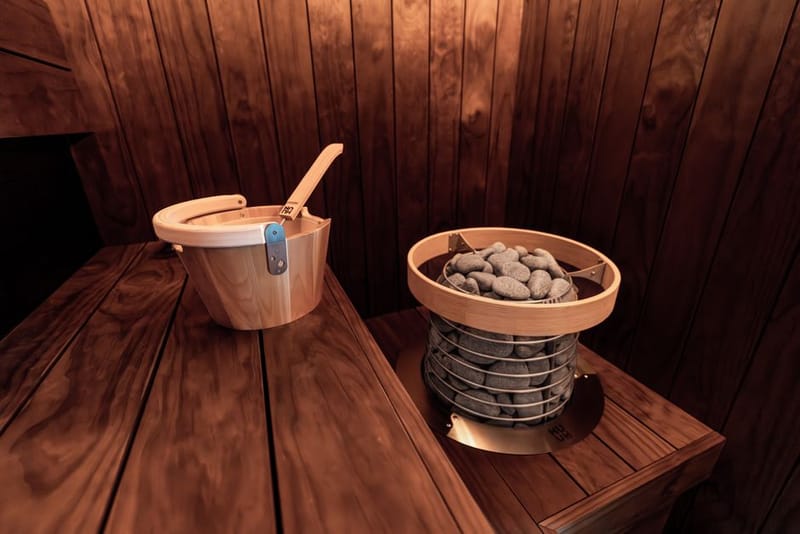
If you've sat in a sauna in Finland or Scandinavia, you've experienced löyly - the wave of steam that hits when someone tips water onto the heater. It's not theatre; it's the central technical element of the traditional sauna experience. This guide covers what it actually does, how to do it properly, and why it matters for home sauna users.
What löyly actually is
Finnish word, specific physics.
Löyly (singular) or löylyt (plural in Finnish) refers specifically to the steam-burst event: the action of pouring water onto the hot sauna stones, and the resulting cloud of steam that rises through the cabin. The word has no exact English equivalent - 'steam' alone misses the ritual aspect, and 'humidity' misses the discreteness of each pour.
In a traditional Finnish sauna, the heater (kiuas) sits exposed in the cabin with a pile of igneous rocks (peridotite, olivine, or similar dense stones with high heat capacity) heated to ~200-300°C. Pouring water onto these rocks causes immediate evaporation. The resulting humidity raises the perceived temperature even though the air temperature changes only slightly - water vapour conducts heat to skin much more efficiently than dry air, so the same cabin feels dramatically hotter for the next 30-60 seconds.
Why it matters: the dry-heat-only sauna problem
A sauna without löyly capability is incomplete.
Many cheaper home saunas, particularly entry-level infrared models, are not designed for löyly:
- Infrared saunas heat your body directly via infrared emitters; they don't have a stone-stove heater so water-on-rocks isn't applicable. You can run an electric humidifier but it's a different experience.
- Some basic electric Finnish saunas have small heaters or enclosed-element designs that aren't rated for water exposure. Pouring water on them can damage the heater or trip the safety cutout.
- Wood-fired traditional saunas are designed for löyly from the ground up. Pile of stones above firebox; throw water freely; this is the default mode of operation.
For UK buyers looking at a home sauna who want the löyly experience, you need either a wood-fired model or an electric model with a proper exposed-stone heater (Harvia, Tylo, Narvi, Saunum are the established UK-market brands that make these). See our home sauna buying guide for the wider category considerations.
The protocol: how to do löyly properly
Less water more often is the rule.
Five practical rules for löyly:
- Use a wooden ladle (kauha) and bucket (kiulu). Cheap, traditional, won't burn your hand or scratch the stones. A 0.5-1 litre bucket + a 100-150ml ladle is the standard combination.
- Pour onto the centre of the stone pile, not the edges. The centre stones are hottest; you get the maximum steam burst. Edge pours cool quickly and waste water.
- Small amounts at a time, every 1-3 minutes. A 100ml ladle every 90 seconds keeps the humidity climbing gradually. Drenching the stones with 500ml at once cools them, produces less total steam, and risks tripping a thermal cutout if you have an electric heater.
- Listen to the others in the sauna. In a multi-person sauna, ask 'lisää löylyä?' (more löyly?) before pouring - some people prefer drier sessions. Sauna etiquette is taken seriously in Finland.
- Add essential oil sparingly. Small drop of eucalyptus or birch oil in the water is traditional. More than a drop and it becomes overwhelming + can irritate eyes. Always check oils are sauna-safe (not all are).
Löyly + safety: when to ease off
Humidity drives perceived temperature - know the limits.
Löyly amplifies the cardiovascular load of a sauna session. In a traditional Finnish sauna at 80°C air temperature, throwing 200-300ml of water can briefly raise the perceived temperature equivalent to 100-110°C of dry heat. This is fine for healthy adults but worth knowing:
- If you're new to sauna, start with no löyly or very small pours. Build tolerance over weeks.
- If you feel dizzy, lightheaded, or your heart is racing harder than you'd expect from moderate exercise, stop adding löyly and exit when comfortable.
- If you have any cardiovascular condition (see our sauna + heart health guide for the full list), aggressive löyly is one of the things to be conservative about - your cardiologist's 'OK for moderate exercise' frame is the right calibration.
- If you're pregnant, don't do löyly even if sauna in general has been cleared. Core temperature above 39°C is associated with neural-tube risks (most UK obstetric guidance is conservative on sauna in pregnancy).